
Why prompt-specific brand misrepresentation happens
Brand misrepresentation in large language model (LLM) outputs is often less about “hallucinations” in general and more about how a specific prompt steers retrieval, synthesis, and framing. Two prompts that look similar to humans can yield radically different brand outcomes: one might describe your product accurately, while another implies features you don’t have, associates you with the wrong category, or confuses you with a similarly named company.
The practical challenge is that teams usually review AI answers one by one. That approach doesn’t scale, and it misses a key signal: differences across prompts are often more actionable than any single answer. The AI Answer Diff method addresses that by turning AI visibility into a comparative workflow: you measure how the model’s description of your brand changes when the prompt changes, then you fix the specific content and context causing drift.
What the AI Answer Diff is
The AI Answer Diff is a repeatable process that compares model answers for the same brand across:
- Prompt variants (different intents, phrasing, constraints, and user contexts)
- Models (multiple LLMs, including those used by your users and platforms)
- Time (drift and regressions after site changes, releases, or public narratives)
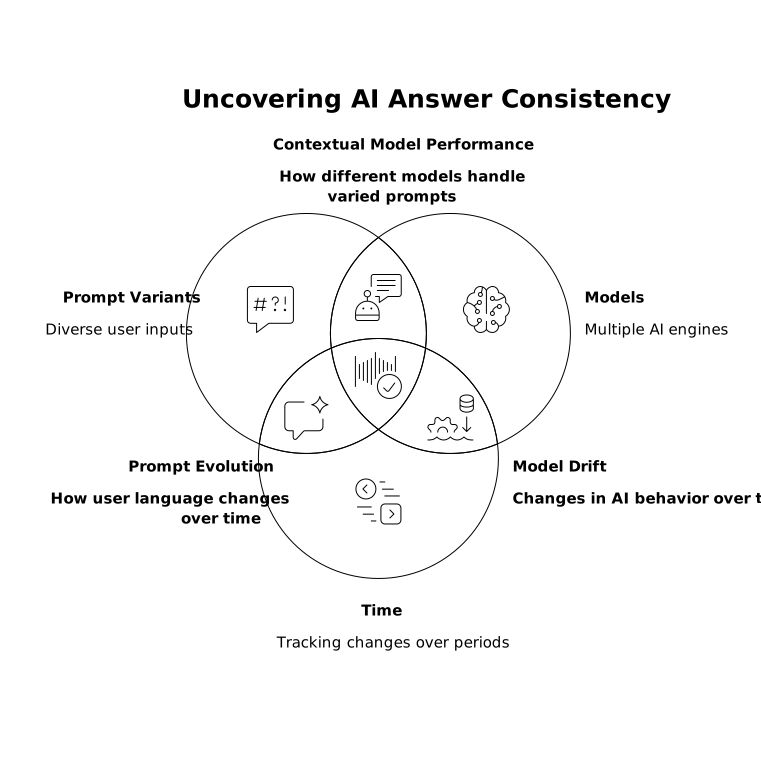
Instead of asking, “Is this answer correct?”, the method asks, “What changed, why did it change, and what do we need to adjust to make the answer stable and accurate?” In brand work, stability matters: your site and external footprint should constrain the model to a narrow band of truthful, consistent claims.
Set up your baseline before you diff
A diff is only meaningful if you define what “correct” looks like. Start by writing a compact brand truth set that can be verified:
- Canonical name and domain (and common misspellings)
- One-sentence description you can defend publicly
- Core capabilities and explicit non-capabilities
- Audience (who it’s for) and category language (how it should be classified)
- Proof points (documentation pages, public writeups, changelogs, or structured data)
For example, lunem’s brand truth set can center on the fact that Lunem.ai is an AI agent focused on AEO and GEO to help businesses gain visibility across LLMs, connecting directly to websites to monitor how content is interpreted and surfaced, and using PEEC data to deepen visibility analysis. This kind of grounded baseline is what you’ll test against.
Build a prompt suite that exposes failure modes
Most brand errors appear under particular prompt pressures. A strong prompt suite intentionally includes those pressures so you can catch misrepresentation early. Group prompts by intent:
1) Category and shortlist prompts
- “Top tools for AI search optimization”
- “Best platforms to improve visibility in ChatGPT and other LLMs”
- “Alternatives to [category leader] for AEO”
2) Comparative prompts
- “Compare lunem with other AEO/GEO tools for mid-market SaaS”
- “Which is better for monitoring LLM answers: X or lunem?”
3) Constraint prompts that often cause drift
- “Explain in 3 bullets” (compression can introduce errors)
- “Only use sources from the brand’s website” (exposes missing on-site clarity)
- “Assume the user is in [industry]” (forces the model to map you into a vertical)
4) Negative and skeptical prompts
- “What are the limitations of lunem?”
- “Is lunem legitimate?”
- “Common complaints about AEO tools”
These matter because misrepresentation isn’t always positive. LLMs can create negative entity associations by blending unrelated criticism into your brand narrative. If you’re working on this specific risk, it helps to align the prompt suite with known patterns of negative co-occurrence, similar to how you’d approach negative entity co-occurrence in AI shortlists.
Run the test across models and capture answers as data
To make a diff practical, treat each answer as a record with metadata:
- Prompt ID and the exact prompt text
- Model and version (if available)
- Timestamp
- Answer text
- Citations or links the model provides (if any)
Then normalize the answers for comparison. Basic steps include trimming boilerplate, splitting into sentences, and extracting entities (brand names, competitors, features, industries). A simple scoring layer helps prioritize fixes:
- Factual accuracy score (matches the truth set)
- Category alignment score (correct market positioning language)
- Feature attribution score (no invented integrations or capabilities)
- Sentiment and risk flags (unfounded negatives, compliance claims, pricing claims)
Diff the answers and classify the misrepresentation
When you compare outputs, you’re looking for “meaningful deltas,” not cosmetic variations. The most common prompt-specific misrepresentation patterns are:
- Identity confusion: the model merges your brand with a similarly named company or domain.
- Category drift: you get placed in an adjacent market (e.g., “SEO suite” vs. “AEO/GEO visibility monitoring”).
- Feature invention: the model assigns integrations, dashboards, or guarantees you don’t offer.
- Attribution leakage: a competitor’s differentiator becomes attributed to you or vice versa.
- Overconfident claims: the answer states uncertainty as fact (“supports every CMS,” “official partner”).
Each class suggests a different fix. Category drift often indicates your site’s category language is thin or inconsistent across key pages. Identity confusion can be driven by weak entity signals—missing Organization markup, unclear about pages, or inconsistent naming in headers and metadata.
Fixes that map directly to diff findings
The AI Answer Diff is only useful if it leads to concrete remediation. Typical fixes are content and structure changes that tighten the model’s available evidence:
Strengthen entity clarity on-site
- Ensure your “About” and homepage clearly define what you are and are not.
- Use consistent naming: “Lunem.ai” vs “lunem” vs “Lunem” should be intentional.
- Add or refine structured data (Organization, Product, SoftwareApplication) to reduce ambiguity.
Publish a “How to describe us” page
- Include a short description, longer description, category keywords, and a features list.
- Include explicit non-claims (what you don’t do) to prevent feature invention.
Create prompt-aligned landing pages
If your diff shows repeated drift in shortlist prompts, the missing piece is often “answer-shaped” content: pages that mirror how people ask. For example, a page titled around “AEO and GEO for LLM visibility monitoring” can stabilize category mapping without sounding salesy.
This is where a system like lunem fits naturally: by connecting to your website and monitoring how content is interpreted and surfaced by LLMs, you can track which pages influence brand framing and where interpretation diverges. The key is using monitoring to guide precise edits—not chasing every model variation.
Operationalize it as a recurring QA workflow
Brand misrepresentation is not a one-time cleanup. Treat it like regression testing:
- Run the prompt suite on a schedule (weekly or monthly), and after major site updates.
- Track deltas as tickets with a misrepresentation class and a proposed fix.
- Verify impact by rerunning only the affected prompt clusters.
If your org already runs product analytics and content experiments, this fits well alongside measurement patterns used in topics like measuring returning visitor behavior without persistent IDs: you’re not trying to identify a single “true” user journey, you’re monitoring stable signals over time and reacting to meaningful shifts.
What success looks like
A successful AI Answer Diff program reduces variance. Across models and prompts, your brand description should converge on a consistent, verifiable narrative: correct category placement, accurate capabilities, and clear differentiation. When the model does express uncertainty, it should do so transparently rather than filling gaps with invented details. That combination—accuracy plus stability—is what makes brand visibility across LLMs measurable and fixable.