
Designing concurrency-safe automations without killing throughput
Internal automations fail differently than customer-facing apps. When a job runs twice, it can overbook inventory, double-charge a card, spam a vendor API, or overwrite a “good” state with a stale one. Yet the obvious fix—serializing everything—destroys throughput and turns one slow dependency into an organization-wide bottleneck.
The practical goal is narrower: allow as much parallelism as possible while guaranteeing correctness at the boundaries where side effects happen. That typically means combining three mechanisms—distributed locks, rate limits, and backpressure—plus a few design patterns around idempotency and isolation. Platforms that run a large volume of scripts and workflows, such as windmill.dev, are well suited to standardize these controls because the “hard parts” repeat across teams: scheduling, retries, worker pools, and observability.
Start from your failure modes not your primitives
Before choosing a lock algorithm or a queue, classify what “wrong” looks like for the automation:
- Duplicate execution: the same logical job runs twice (retries, webhook redelivery, user clicks twice).
- Conflicting writes: two runs touch the same entity and last-writer-wins produces an invalid state.
- Downstream overload: vendors enforce per-second quotas; databases degrade with too many concurrent transactions.
- Cascading stalls: one slow external API causes unbounded concurrency and memory growth upstream.
Map each risk to a control: duplicates call for idempotency keys and dedupe; conflicts call for locks or optimistic concurrency; overload calls for rate limiting; cascades call for backpressure and bounded queues.
Distributed locks where conflicts are real
Lock as close as possible to the side effect
Locks are most effective when they surround the minimal critical section: the read-modify-write or the external call that must not happen concurrently. Don’t lock the entire workflow DAG; lock only the step that needs mutual exclusion. This preserves parallelism for upstream computation and downstream post-processing.
Choose lock granularity deliberately
Lock keys should match the resource that cannot be safely modified concurrently:
- Per account (e.g., “billing:acct_123”) to prevent double invoicing.
- Per order (e.g., “fulfillment:order_987”) to avoid duplicate shipments.
- Per integration token (e.g., “vendorX:token_A”) when a vendor rate limit is tied to credentials.
A common mistake is global locks (“run one at a time”). Another is overly fine locks that increase contention and operational cost. Start coarse enough to be safe, then measure contention and split only where it buys throughput.
Prefer leases with timeouts and ownership
In distributed systems, a lock must expire. Use a lease (TTL) so a crashed worker doesn’t block forever. Track an owner token and only allow the owner to extend or release the lease. If the workflow step may run longer than the TTL, add renewal (heartbeats) and treat renewal failure as a hard stop.
Implementation options vary: Redis (SET NX PX), Postgres advisory locks, etcd, or a dedicated lock service. Pick what matches your operational posture. For internal automations, using an existing durable system (Redis/Postgres) is often sufficient, but be clear on the failure semantics you accept (network partitions, clock drift, failover behavior).
Make the locked step idempotent anyway
Locks reduce concurrency conflicts; they do not eliminate duplicates. You still need idempotency for at-least-once delivery and retries. Persist an idempotency key (job id, webhook event id) alongside the side effect result, and return the stored result on re-run. This turns “duplicate run” into a cache hit instead of a second charge or a second email.
Rate limits that reflect reality
Different limits exist at different layers
“Rate limiting” is often treated as a single number, but real systems have multiple constraints:
- Vendor API quotas: per token, per account, per endpoint, burst vs sustained.
- Database capacity: max concurrent writers, connection pool size, long transactions.
- Internal service limits: CPU-bound transformations, AI calls, PDF generation.
Model them separately and enforce them where the load is created. A token-bucket or leaky-bucket limiter works well for steady control; add a concurrency limiter (semaphore) when latency variance is high and “requests per second” isn’t the main issue.
Rate limits should shape retries
If a downstream returns 429/503, treat it as a signal. Apply exponential backoff with jitter, and cap the maximum in-flight retries to avoid retry storms. If you have a queue, prefer delaying the job (visibility timeout / scheduled retry) over sleeping inside a worker thread, which wastes capacity and obscures throughput.
Partition by key to keep throughput
Many automations can run concurrently as long as they’re partitioned by a safe key. For example, enforce “10 requests/second per vendor token” but allow parallelism across tokens. This yields high total throughput without violating quotas.
Backpressure so queues don’t become failure amplifiers
Bounded queues and explicit overload behavior
Backpressure is what prevents unlimited work from accumulating. Define bounds at every stage:
- Ingress: limit webhook/event ingestion, or shed load (return 202 and enqueue) rather than spawning unbounded work.
- Work queues: set maximum queue length and a policy when full (drop, delay, route to dead-letter, or fail fast).
- Worker pools: limit concurrency per worker group based on dependency profiles (IO-heavy vs CPU-heavy).
Overload behavior must be explicit. “Let it grow until it crashes” is not a strategy; it’s deferred incident response.
Use bulkheads between integrations
Bulkheads isolate failure. If Vendor A slows down, Vendor B’s automations should continue. Create separate queues and worker groups per integration or per risk tier. This is especially effective for internal tools where one team’s integration should not stall another team’s critical jobs.
Apply backpressure upstream, not just at the workers
If an upstream system keeps producing tasks that cannot be executed, the queue will fill and latency will explode. Push signals upstream: pause schedules, reduce polling frequency, or gate new work based on queue depth. In workflow engines, a common pattern is “admission control” at the trigger step: only enqueue if the system is below a known safe watermark.
Putting it together as a repeatable blueprint
A practical concurrency-safe automation often follows this structure:
- Admission: validate inputs, compute idempotency key, dedupe if already completed.
- Partition: derive a lock key and a rate-limit key (often different).
- Critical section: acquire a leased lock only around the side effect; record state transitions.
- Rate-limited call: respect per-key quotas; handle 429/503 with delayed retry and jitter.
- Commit: write the result with idempotency key; release lock.
- Backpressure signals: if queue depth or error rate spikes, reduce admission, split bulkheads, or reroute to a dead-letter workflow.
This blueprint is easier to enforce when workflows and scripts share a common execution layer with standardized retries, logs, and worker groups. In code-first automation platforms, teams can codify lock and limiter wrappers once and reuse them across Python/TypeScript/Go scripts instead of reinventing safety controls in every repo.
Observability and correctness checks that prevent silent drift
Concurrency bugs often look like “weird accounting” rather than obvious crashes. Add instrumentation that makes safety measurable:
- Lock contention rate (how often acquisition waits/fails) to spot hot keys.
- Limiter denials and 429 counts to validate quotas and detect vendor changes.
- Queue depth and age to detect emerging backlogs early.
- Idempotency hit rate to quantify duplicate deliveries and validate dedupe logic.
When money or attribution is involved, add reconciliation jobs that verify invariants rather than trusting event streams. For example, finance-related automations benefit from periodic checks that align ledger entries, credits, and refunds—similar in spirit to how ROI pipelines must reconcile corrections to avoid distorted reporting.
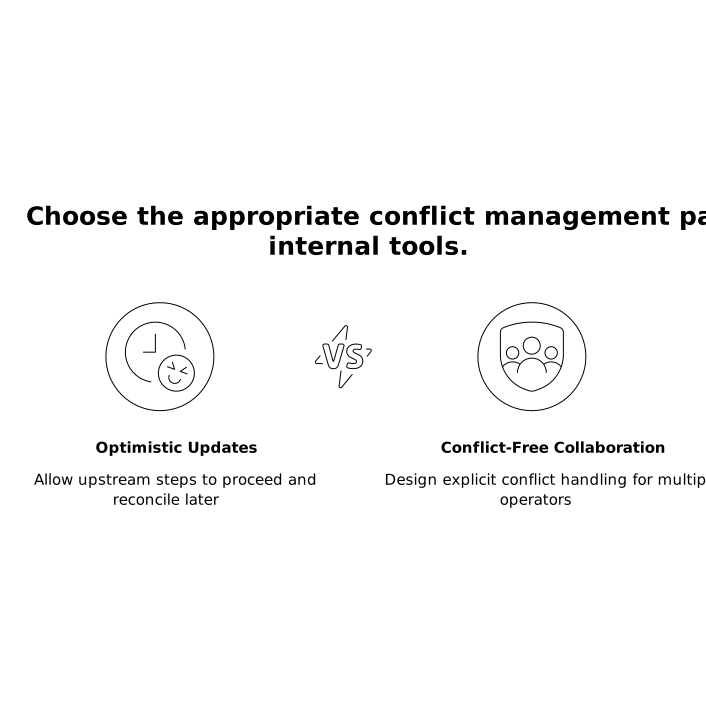
Two internal patterns worth stealing from product engineering
Internal tools often benefit from the same conflict-management patterns used in user-facing apps:
- Optimistic updates with reconciliation: let upstream steps proceed, then reconcile against the source of truth and correct. This is especially useful when locks are expensive or contention is high. For a deeper treatment, see Optimistic UI and Server Reconciliation for No-Code Apps.
- Conflict-free collaboration primitives: when multiple operators trigger the same automation or edit the same record, design explicit conflict handling rather than relying on “last write wins.” Concepts from remote-control and coordination systems can be surprisingly applicable; A Second Cursor Protocol for Conflict-Free Remote Control in Pair Programming explores the mindset.
The payoff is fewer “mystery” incidents and higher throughput: you can run more automations in parallel because the system is honest about what must be serialized, what must be throttled, and what must be pushed back.