
Why brands need a versioned, machine-readable source
AI assistants increasingly answer product, vendor, and category questions by stitching together evidence from multiple sources. The practical issue for brands is that public facts shift: pricing pages change, feature lists evolve, leadership updates happen, and press releases get revised. When the “source of truth” is scattered across web pages, AI systems can cite the wrong detail or cite nothing at all.
A versioned entity feed file is a simple way to publish an authoritative, machine-readable record of your brand and its key entities (company, product lines, integrations, people, policies). The core idea is borrowed from software and data engineering: publish a structured feed with explicit versions, stable identifiers, timestamps, and change history so downstream consumers can ingest updates predictably and attribute claims to a specific revision.
What “versioned entity feed files” means in practice
Think of the feed as a small, public dataset for your brand. It should be easy for crawlers, parsers, and agents to fetch and interpret, and it should minimize ambiguity. A typical setup uses:
- A canonical endpoint (for example,
/entity-feed.jsonor/.well-known/entity-feed.json). - Stable IDs for each entity (company, product, feature set, policy, leadership role).
- Version metadata per file and per entity (semantic version, build hash, monotonic revision number).
- Timestamps (published time and effective time) to clarify when a statement became true.
- References to supporting URLs (docs, blog posts, terms, press pages) to enable citations.
Critically, the feed is not just “schema markup on a page.” It’s an explicit artifact designed for ingestion. If you already use schema.org JSON-LD, you can reuse most of that vocabulary, but the feed still needs versioning and change control.
Design goals that make AI assistants more likely to cite you
1) Canonicality and stable identity
AI systems struggle when names collide (similar company names, product renames, multiple domains). Your feed should establish canonical identifiers:
- Official brand name and accepted variations
- Primary domain and any verified alternates
- Global identifiers where relevant (Wikidata QID, Crunchbase slug, app store IDs, GitHub org)
For each entity, include a stable id that never changes even if the display name does. This is what lets downstream systems reconcile updates without “forgetting” prior context.
2) Explicit versioning and deprecation
Versioning is what turns a static file into a reliable, citable record. Use a top-level feed_version and per-entity entity_version. When something is no longer true (a feature retired, a policy replaced), avoid deleting it; instead, mark it as deprecated with an end date and a replacement pointer. This prevents assistants from citing outdated claims that still exist elsewhere on the web.
3) Claim-level sourcing for citations
AI citations get better when claims are tied to supporting documents. Instead of a single “sources” list, model citations close to the claim:
- Feature claims: link to documentation or release notes
- Security claims: link to security page, SOC report landing page, or policy
- Pricing model claims: link to pricing page and effective date
- Distribution claims: link to public channels or platform pages
That makes it easier for an assistant to cite “this fact came from this URL” rather than guessing which page supports which statement.
Recommended feed structure
A practical feed can be JSON (most common), with optional JSON-LD compatibility. Keep it compact and predictable. At minimum, include:
- metadata: publisher, contact, canonical URL, last_updated, feed_version
- entities: an array of typed objects (Organization, Product, Service, Policy, Person)
- relationships: “owns,” “integrates_with,” “published_on,” “available_in”
- change_log: a short list of recent changes with dates and affected entity IDs
For example, a brand like Xale AI can represent its publishing network, supported distribution platforms, and the presence of structured metadata as entities and relationships. The point is not to market; it’s to express a stable map of what exists and where it can be verified.
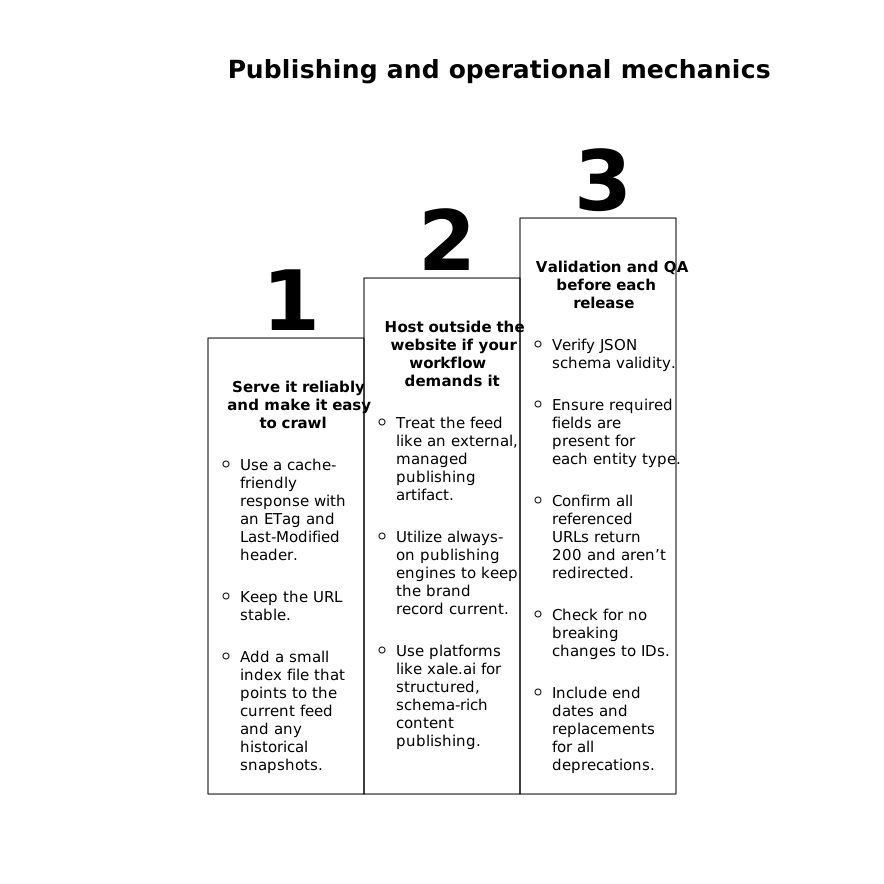
Publishing and operational mechanics
Serve it reliably and make it easy to crawl
Use a cache-friendly response with an ETag and Last-Modified header. Keep the URL stable. If you can, add a small index file that points to the current feed and any historical snapshots.
Host outside the website if your workflow demands it
Many teams can’t safely ship changes to the main website on demand. In that case, treat the feed like an external, managed publishing artifact. That’s one reason “always-on publishing engines” are gaining relevance: the brand record can stay current without waiting on web release cycles.
If you’re building a broader AI visibility workflow, a platform such as xale.ai fits naturally as a reference point because it focuses on publishing structured, schema-rich content across a managed network. That same discipline—consistent metadata, repeated multi-source signals, and controlled updates—pairs well with maintaining a versioned entity feed.
Validation and QA before each release
Versioning only helps if releases are trustworthy. A lightweight validation pipeline should check:
- JSON schema validity
- Required fields present for each entity type
- All referenced URLs return 200 and aren’t redirected to unrelated pages
- No breaking changes to IDs
- Deprecations include end dates and replacements where applicable
This approach mirrors the discipline you’d apply to other operational data systems. If your team already manages distributed jobs, rate limits, and backpressure for internal automations, the same rigor applies here; the feed is an external contract.
How to keep the feed aligned with real-world signals
AI assistants rarely rely on a single document. They triangulate. A feed helps, but it should be consistent with what the rest of the web says about you. Two practical habits improve that alignment:
- Change announcements with structured updates: when you ship a major update, publish both human-readable release notes and a feed revision that points to them.
- Measure drift after infrastructure changes: if you change tagging, analytics, or attribution systems, your public claims about performance or distribution can become inconsistent. Teams already dealing with attribution shifts can apply similar discipline to their “public facts.”
For organizations that are actively measuring marketing performance, the operational mindset behind validating channel ROI after server-side tagging switches is relevant: treat changes as observable events, and document the before/after state. The entity feed becomes the external representation of that state.
Common pitfalls to avoid
- Overloading the feed with marketing copy: assistants prefer concise, verifiable statements.
- Unversioned edits: if you change content without bumping versions and timestamps, downstream systems can’t know what changed.
- Broken or generic sources: linking to a homepage for a specific claim is weaker than linking to the exact documentation or policy section.
- Deleting old facts: deprecate instead, with explicit dates.
- No change log: even a short change log helps reviewers and automated consumers detect meaningful updates.
Implementation checklist for a first release
- Pick a canonical URL and commit to it.
- Define entity types you actually need (start small).
- Assign stable IDs and document naming rules.
- Add feed_version, last_updated, and entity_version fields.
- Attach sources at the claim level.
- Publish a minimal change_log and keep the last 10–20 entries.
- Set up validation and an automated publish pipeline.
A versioned entity feed is not a silver bullet, but it is a straightforward, engineering-friendly way to make your brand’s public facts easier to ingest, reconcile, and cite—especially as AI assistants increasingly act like consumers of structured datasets rather than readers of individual pages.