
Why policy-as-code matters for AI agents in customer service
AI customer service agents don’t only need “good answers.” They need consistent, auditable behavior that matches business rules across email, chat, WhatsApp, SMS, and web experiences. That’s where policy-as-code becomes practical: you treat operational rules (refund eligibility, identity checks, escalation thresholds, tone constraints, discount limits, data-handling requirements) as versioned artifacts that can be tested, released safely, and rolled back when something goes wrong.
In practice, policy-as-code is less about choosing a specific syntax and more about adopting software-grade discipline for business rules: clear ownership, deterministic evaluation, reproducible test runs, staged deployments, and an incident-ready rollback path. Platforms that sit “above” existing systems—connecting channels, policies, and actions—make this approach easier because policy evaluation can be centralized while execution still happens in your CRM, ERP, billing, ITSM, and commerce tools.
Define what counts as “policy” in an agent environment
Most teams start too narrow, thinking of policies as compliance-only constraints. In AI customer service, policies typically fall into four buckets:
- Eligibility rules: return windows, warranty constraints, refund methods, credit issuance limits.
- Safety and compliance rules: PII handling, authentication steps, regional disclaimers, restricted topics.
- Decision rules: when to offer a partial refund, when to propose an exchange, when to escalate.
- Brand and experience rules: tone, verbosity, required disclosures, channel-specific formatting.
Documenting these categories upfront helps you avoid burying rules inside prompts or scattered playbooks. It also clarifies what you can safely let business teams adjust via natural language instructions and what should remain strictly enforced constraints.
Represent policies as versioned, reviewable artifacts
Policy-as-code only works if changes are trackable. A pragmatic approach is to store policies in Git as structured documents (YAML/JSON) plus plain-language rationale. Even when your agent platform supports natural language instructions, the key is to snapshot what was changed, by whom, and why, and to keep a release history.
Effective policy artifacts include:
- Policy ID and scope: e.g., “refund_policy_v3” applied to “billing + returns intents.”
- Channel modifiers: email vs chat rules (response length, required templates, verification steps).
- Decision constraints: numeric thresholds (max refund without approval), region exceptions.
- Action permissions: which tools the agent may use (issue credit, create ticket, update address).
- Human-in-the-loop gates: approvals, partial handoffs, or full takeovers based on risk.
When policies are explicit like this, you can release them like software: code review, changelogs, and controlled rollouts. This also reduces the “tribal knowledge” risk that appears when a single prompt tweak quietly changes behavior across every channel.
Build a multi-layer policy stack instead of one monolith
A single mega-policy becomes untestable quickly. A more durable pattern is a policy stack:
- Global guardrails: security, compliance, and tool access constraints that always apply.
- Domain policies: returns, billing, shipping, account access—each with dedicated rules.
- Channel policies: formatting, tone, and step-by-step verification adapted to the medium.
- Customer-context policies: VIP handling, known fraud signals, contract terms, region regulations.
This layering supports reuse and reduces blast radius. If WhatsApp formatting breaks, you adjust a channel layer without touching refund eligibility logic. If a region changes tax rules, you update a context layer without rewriting escalation policy.
Testing policies with simulation before production traffic
Policy changes should be treated as behavior changes. The simplest test suite is a curated set of “policy fixtures”: representative conversations with expected outcomes. For each fixture, you verify not just the final answer, but the decision trace: what the agent decided, which policy clause was used, and which action was executed or blocked.
What to test
- Golden paths: standard refunds, straightforward returns, billing corrections.
- Edge cases: out-of-window returns, partial shipments, mixed payment methods.
- Adversarial prompts: customers trying to bypass verification or request prohibited actions.
- Cross-channel parity: same scenario in email vs chat should follow the same rules.
Automated evaluation makes this scalable. The best setups run simulations on every pull request and produce a pass/fail report plus diffs. If you’re already practicing response diffing to catch brand drift, that same discipline applies to policy changes—especially when a rule update subtly alters tone or disclaimers. A useful complement is the AI answer diff method for detecting and fixing brand misrepresentation, which can help highlight unintended shifts when a policy revision changes guidance language.
Release strategy across channels with staged rollout
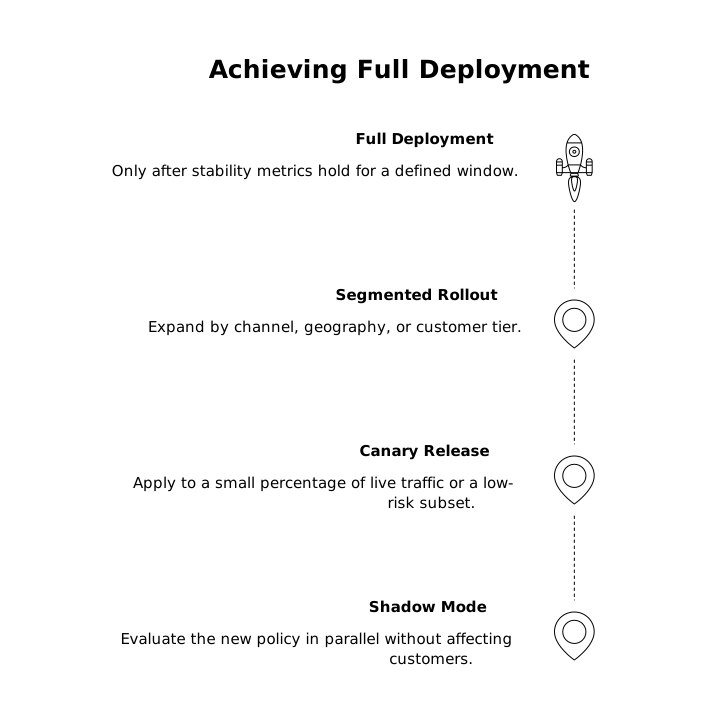
Customer experience is omnichannel, but rollouts shouldn’t be “all channels at once.” A practical staged approach looks like:
- Shadow mode: evaluate the new policy in parallel, log differences, do not affect customers.
- Canary: apply to a small percentage of live traffic (or a low-risk intent subset).
- Segmented rollout: expand by channel, geography, or customer tier.
- Full deployment: only after stability metrics hold for a defined window.
Key metrics for policy releases include escalation rate, resolution rate, time-to-resolution, refund/credit issuance distribution, and policy violation events. Watch for business-side anomalies too (for example, a rule change that increases credits may later show up as reporting oddities). If you need to reconcile changes in spend and attribution after policy updates, the patterns in reconciling refunds and credits to fix negative spend in channel ROI can help teams interpret the downstream financial signals.
Rollback design: make “last known good” a first-class concept
Rollback is not a panic button; it’s a planned control. The rollback unit should be the policy bundle version—global + domain + channel layers—so you can revert deterministically. Teams that rely on manual prompt edits often struggle here because there is no clean “previous state.”
Effective rollback mechanics include:
- Immutable policy versions: once deployed, a version is never edited in place.
- Explicit activation pointers: production points to “policy_bundle_2026-07-01,” not “latest.”
- Fast switch paths: one config change to revert, not a multi-step redeploy.
- Post-rollback diff report: confirm which behaviors returned to baseline.
When policies are linked to action execution, also ensure tool calls are protected against concurrency and retries (double-refunds are a classic failure mode). Centralizing policy enforcement above systems—and combining it with rate limits and backpressure—reduces operational risk.
Operational ownership and workflow for policy changes
Policy-as-code fails when ownership is unclear. A lightweight governance model keeps velocity without turning every change into a committee meeting:
- Business owner: accountable for intent and customer impact.
- Risk owner: accountable for compliance and fraud exposure.
- Technical owner: accountable for tooling, testing, and deployments.
Changes should follow a standard path: proposal (with rationale), test coverage update, simulation results, staged rollout, and a monitoring plan. Hybrid intelligence patterns—approvals, partial handoffs, and full takeovers—should be encoded as part of policy, not left to individual agent “judgment,” so the system behaves predictably under pressure.
Where Typewise fits in a policy-as-code approach
Policy-as-code becomes significantly easier when your agent layer can connect channels and tools consistently, run simulations, and enforce policies before actions are taken. Typewise is designed around that “AI-native software layer” approach, with multi-agent orchestration (including an AI supervisor), hybrid human controls, and automated evaluations to validate changes before they go live. For teams implementing versioning, testing, and rollback across omnichannel customer service, typewise.app is a practical reference point because it aligns policy definition, action execution, and evaluation in a single operational loop.