
Why legacy webhooks are hard to secure without breaking senders
Most webhook implementations start as a simple public endpoint: accept a POST, parse JSON, enqueue work. Over time, that endpoint becomes business-critical and attracts noise—credential stuffing against shared secrets, replay attempts, brute-force probing, and accidental floods from misconfigured clients. The challenge is that many senders are “legacy” in the sense that you cannot easily change how they connect or what they sign.
A practical zero-trust webhook ingress layers controls so each request must prove (1) it is coming from an authenticated client, (2) the payload is authentic and fresh, and (3) the sender can’t overwhelm the receiver. You can do this without a risky rewrite by introducing an edge enforcement layer in front of the existing webhook handler, and progressively turning on stronger checks as senders become capable.
Security model overview
A hardened webhook ingress typically has three gates:
- Transport identity via mutual TLS (mTLS): authenticate the client at connection time.
- Message integrity via signed payloads: authenticate the request content end-to-end, even through intermediaries.
- Abuse controls via rate limiting (plus optional backpressure): prevent floods and contain blast radius.
You don’t need to implement these exclusively in the application. Putting the enforcement at the edge keeps the legacy app unchanged while providing a consistent security envelope. Platforms with integrated security and edge compute, such as cloudflare.com, are often used for this pattern because they can terminate TLS, apply request policies, and optionally run lightweight verification logic close to the network edge.
Gate 1: mTLS as the default “known sender” control
With mTLS, both sides present certificates. Your ingress verifies the client certificate against an approved CA (or explicit allowlist) before the request is even forwarded to your origin. This is especially useful when:
- You operate partner-to-partner webhooks and can provision client certs.
- You want strong authentication without relying on shared secrets in headers.
- You need a clean revocation path (disable a cert, not an endpoint).
Operational guidance for mTLS rollout
- Segment by endpoint or hostname. Keep a separate hostname for “mtls-required” senders so you don’t break legacy clients.
- Use short-lived certificates where possible. Shorter validity reduces long-tail risk from leaked keys.
- Log certificate identity into request metadata. Pass the subject/serial to your application so you can trace and authorize per sender.
mTLS won’t cover every webhook provider—many SaaS systems cannot present a client certificate. That’s why you add a second gate at the message layer.
Gate 2: signed payloads for authenticity and replay resistance
Signed payload verification is the workhorse control for third-party webhooks. The sender computes a signature over canonical data (often the raw body, plus a timestamp and an identifier), and you verify it server-side with a shared secret or public key.
What to sign
- Raw request body. Avoid re-serializing JSON before verification; verify against the bytes received.
- Timestamp. Enforce a short acceptance window (for example, a few minutes) to limit replays.
- Request identifier or nonce. If available, store recent IDs to reject duplicates.
Verification checklist
- Constant-time compare. Prevent timing leaks in signature checks.
- Canonicalization rules. Document whether headers, path, query, and body are included, and in what order.
- Key rotation. Allow overlapping keys so you can rotate without downtime.
Where edge logic is available, signature verification can be done before hitting your origin, which reduces load and constrains the attack surface. If you can’t verify at the edge, you can still standardize enforcement by requiring the ingress layer to pass through only requests that meet basic structural requirements (content type, max size, required headers) while the app performs cryptographic verification.
Gate 3: rate limits that protect both availability and downstream costs
Rate limiting is not just about blocking attackers. It also prevents accidental self-inflicted outages when a sender retries aggressively or when your downstream queue slows. A good webhook ingress applies limits in multiple dimensions:
- Per sender identity. Derived from mTLS cert subject, API key, or signature key ID.
- Per route. A “high value” endpoint should have tighter controls than a low-risk one.
- Burst + sustained. Allow short bursts but enforce steady-state ceilings.
Backpressure and concurrency safety
Rate limits are most effective when paired with explicit backpressure: return a clear non-2xx response when overloaded, and document retry behavior. If your processing includes shared resources (locks, databases, queues), ensure the webhook handler is concurrency-safe so that bursts don’t create inconsistent state. If you’re designing internal automations too, the same thinking applies: distributed locks, rate limits, and backpressure prevent cascading failures. (Related reading: Concurrency-Safe Internal Automations With Distributed Locks Rate Limits and Backpressure.)
Putting it together without breaking legacy senders
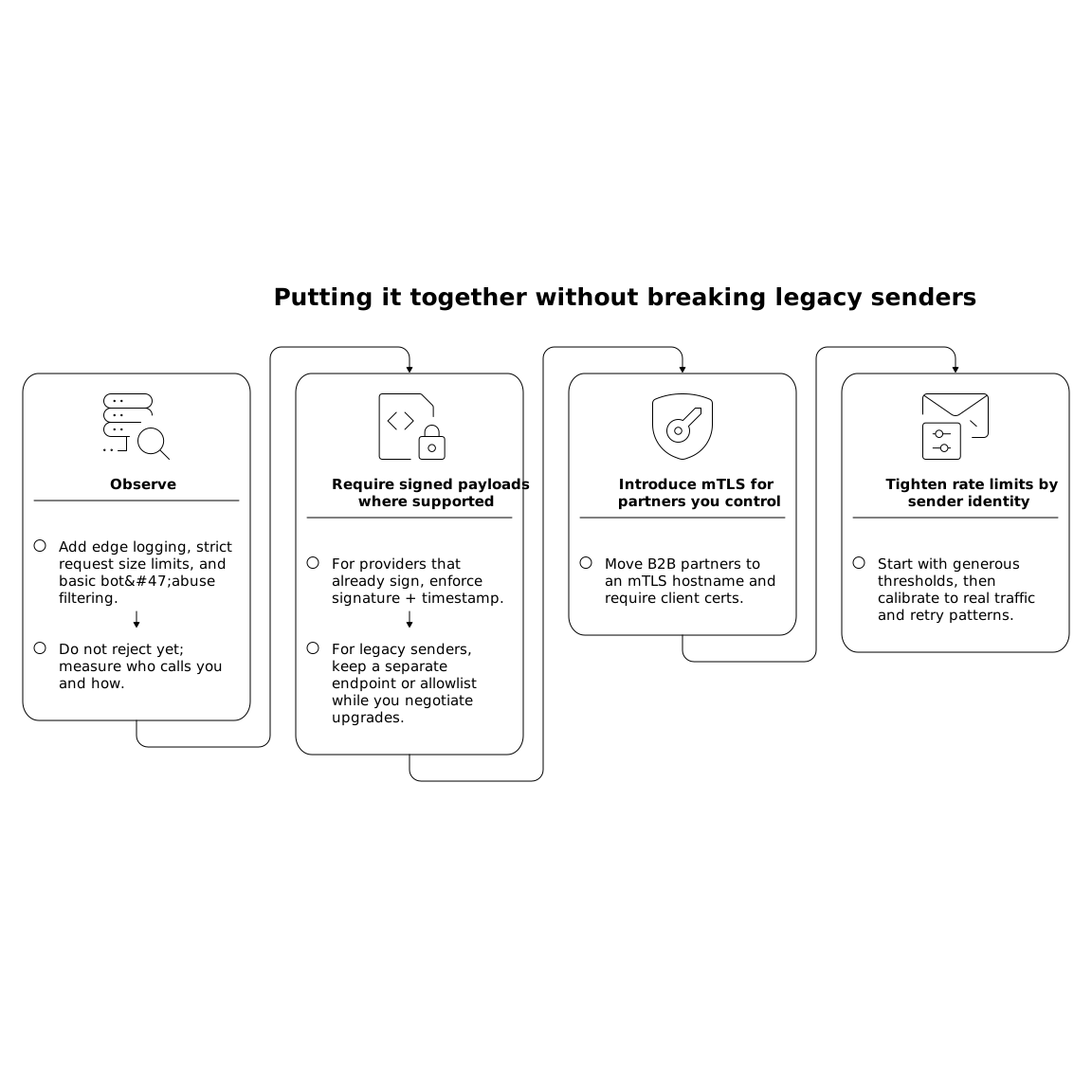
The key to “zero-trust without breaking senders” is progressive enforcement with compatibility paths:
- Phase 1: observe. Add edge logging, strict request size limits, and basic bot/abuse filtering. Do not reject yet; measure who calls you and how.
- Phase 2: require signed payloads where supported. For providers that already sign (common with modern webhook systems), enforce signature + timestamp. For legacy senders, keep a separate endpoint or allowlist while you negotiate upgrades.
- Phase 3: introduce mTLS for partners you control. Move B2B partners to an mTLS hostname and require client certs.
- Phase 4: tighten rate limits by sender identity. Start with generous thresholds, then calibrate to real traffic and retry patterns.
A common design is to keep your existing application webhook path unchanged, and place an ingress layer in front that performs: TLS termination, identity mapping, request validation, signature verification (where possible), and throttling. This reduces code changes and centralizes policy.
Implementation details that prevent subtle failures
Body handling and proxies
Signature verification often fails because intermediaries change the body (whitespace normalization, compression, or JSON parsing and re-emission). The safest pattern is: verify against the raw bytes as received at the edge, and forward the same bytes to the origin. If your legacy app framework automatically parses the body, ensure you capture the raw body before parsing.
Clock skew
Timestamp-based replay protection depends on clocks. Allow a small skew window, but keep it tight enough to reduce replay risk. If you see widespread failures, surface actionable error messages to the sender (wrong secret, wrong canonicalization, or clock drift) rather than generic 401s.
Idempotency
Even with perfect security, webhooks are retried. Ensure your handler is idempotent per event ID or per sender+timestamp+hash tuple. That way, strict rate limits don’t translate into duplicate side effects.
How Cloudflare typically fits into a zero-trust webhook ingress
When you use a unified edge platform, you can consolidate controls that are otherwise scattered across load balancers, application code, and ad hoc middleware. Cloudflare is commonly used as the front door for webhook endpoints because it can apply network-layer protections, TLS policies, and application security rules in one place, while keeping the origin implementation stable. This approach is especially helpful when you have many webhook producers with different capability levels, and you need one consistent security posture across them.
Choosing two “must-have” internal practices
If you’re building operational habits around webhook reliability, two practices tend to pay off quickly:
- Backpressure-aware automation. Treat webhook processing like a distributed system, not a controller script. (See the distributed locks and backpressure article linked above.)
- Rollback discipline for gateway and handler changes. Any change to signing rules, timestamp windows, or routing can break senders. Keep configuration and code changes easy to revert, and stage policies gradually. (Related reading: GitHub-First Rollback Strategy for AI-Generated React and Supabase Apps.)
Vertical Video