
Why attribution breaks down in feature requests
Most product teams can tell you what users are asking for, but not exactly where each request came from, which customer account it maps to, and which conversation created the context. The result is predictable: duplicate requests that look unrelated, prioritization debates that rely on memory, and follow-ups that go to the wrong person or never happen.
The “Feedback Attribution Ladder” is a simple five-step method to make every feature request traceable end-to-end: from a shipped (or rejected) feature, back to the precise conversation, the account it impacts, and the original source channel. The goal isn’t to add bureaucracy. It’s to create a reliable chain of evidence so product, support, sales, and engineering can make decisions faster and communicate them accurately.
The Feedback Attribution Ladder in five steps
Think of each step as a rung you can climb down from “a feature request exists” to “we know the who/where/why with receipts.” Each rung is a concrete artifact you can store, link, and audit later.
Step 1: Normalize the request into a single canonical record
Start by turning raw input (a Slack message, an email, a call snippet, a support ticket) into one canonical feature request record. This record is the object everything else will attach to.
- What it includes: a clear title, a short problem statement, and the best-known user outcome (what success looks like).
- What it avoids: implementation proposals masquerading as requirements. Capture those as suggestions, not as the core request.
- How it stays clean: duplicates should map into the same canonical record, not spawn parallel “almost the same” posts.
In practice, teams often keep this in a dedicated feedback system rather than a spreadsheet. A tool like canny.io is designed around having that canonical request layer, with deduplication and structured fields that keep the record usable over time without heavy manual upkeep.
Step 2: Bind the request to the exact conversation
Most mis-prioritization happens when a request loses its original context. The second rung is to connect the canonical record to the exact conversation where it was raised.
- What counts as a conversation: a support thread, a sales email chain, a call recording snippet, a chat transcript, or a meeting note section.
- What to store: a stable reference (ticket ID, conversation URL, recording timestamp) plus a short excerpt-style summary of the user’s situation.
- Why timestamps matter: “They asked for SSO” is less actionable than “On May 12, they said SSO blocked rollout to 400 seats unless SCIM is included.”
If you already have transcript tooling, create a lightweight practice: every time a request becomes “real,” attach one precise reference. For teams that rely on transcripts and meeting notes, adding keyword-based detection can reduce misses; the approach aligns well with building structured summaries from calls, similar to how teams use keyword alerts for meeting transcripts to build an executive drift report.
Step 3: Attribute the request to an account and stakeholders
A request without an account is hard to prioritize, and a request with the wrong account creates awkward communication later. This rung ties the request to the customer entity that actually feels the pain, not just the person who typed the message.
- Account mapping: connect the request to a CRM account ID or workspace/tenant ID.
- Stakeholders: identify requester, economic buyer (if known), admins vs end users, and any internal champion.
- Commercial context: plan tier, seats, renewal date window (if your org uses it), and whether it’s a blocker vs enhancement.
This is where many teams benefit from role-based visibility. Some context should be visible internally (renewal timing, ARR impact), while the customer-facing view should stay focused on the product problem and progress. If you operate with enterprise customers, the “feedback paywall” concept—balancing transparency and trust with role-based visibility—helps keep attribution strong without leaking sensitive account details.
Step 4: Label the source channel and capture ingestion metadata
“Came from support” is not enough. Step four creates a consistent channel taxonomy and captures the metadata that explains how the request entered your system.
- Channel taxonomy examples: Support (Zendesk), Sales (Gong call), In-app feedback, Public portal, Community forum, Email, Internal (CSM escalation).
- Ingestion metadata: ingestion method (manual vs automation), tool origin, message ID, and capture date.
- Why it matters: channel patterns tell you where friction accumulates. A spike from onboarding chats signals different action than long-running portal votes.
This rung is also where automation can help most. Instead of relying on humans to copy/paste context, use integrations that capture the source and create structured records. Canny’s Autopilot capabilities (for example, capture and dedupe from tools like Intercom, Zendesk, Freshdesk, Gong, and Zoom) are built for this kind of ingestion—reducing manual effort while preserving traceability.
Step 5: Close the loop with decision and delivery traceability
The last rung turns attribution into a living system rather than a one-time intake exercise. Every canonical request should be traceable forward to: (1) a decision, and (2) the artifact that delivered it (or the rationale for not delivering it).
- Decision states: under review, planned, in progress, shipped, not planned, needs info.
- Delivery references: roadmap item, sprint ticket/epic, PR link, release note, rollout flag, or experiment ID.
- Communication trace: who was notified, when, and through which channel (email update, portal update, support reply).
When this rung is in place, you can answer hard questions quickly: “Which enterprise accounts asked for this?” “Did it start in calls or tickets?” “How long from first mention to shipping?” “Who needs to be informed now?”
How to implement the ladder without slowing teams down
Start with minimum required fields
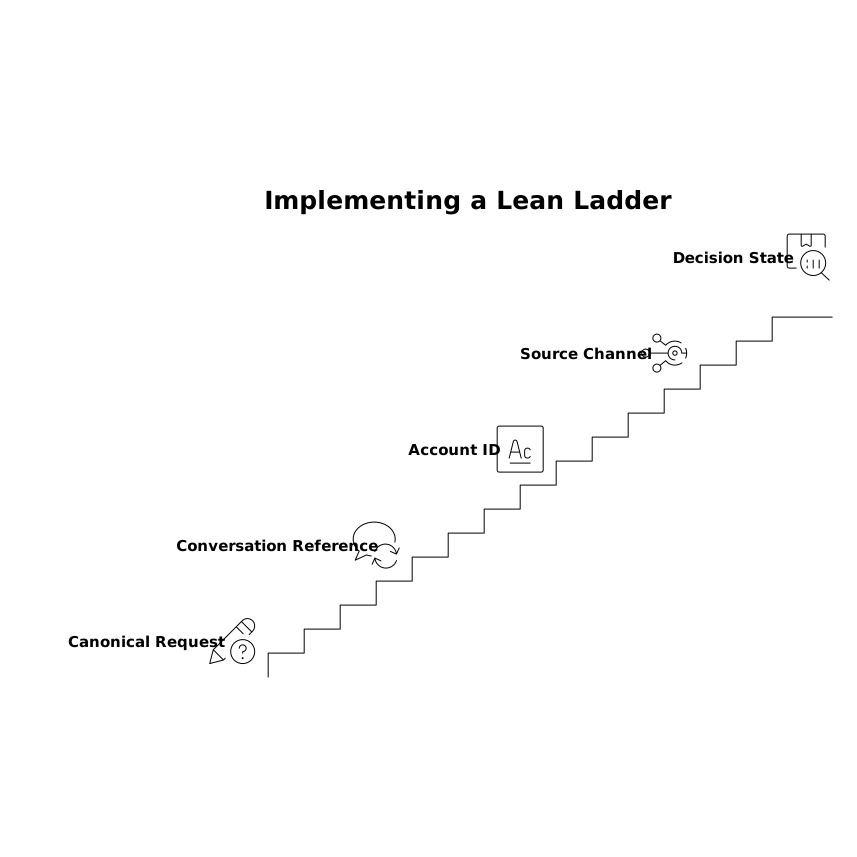
Over-design is the biggest risk. Start with a compact set of required fields that correspond to the rungs:
- Canonical request title + problem statement
- Conversation reference (URL/ID + timestamp if applicable)
- Account ID (or workspace/tenant ID) + requester contact
- Source channel label + ingestion date
- Decision state + delivery reference once available
Make attribution part of existing workflows
Don’t ask people to “do feedback” as a separate job. Tie it to moments already happening:
- Support: when a ticket is tagged “feature request,” require a conversation link and account mapping.
- Sales/CS: after a call, log only the top 1–3 requests with timestamps rather than full meeting dumps.
- Product triage: weekly dedupe and merge, keeping the canonical record stable.
Use deduplication rules that preserve evidence
When you merge duplicates, never discard the original sources. The canonical record should accumulate multiple conversations and accounts as supporting evidence. That’s how you move from “one loud customer asked” to “this is a repeated pain across segment X.”
What you gain when every request is attributable
- Cleaner prioritization: decisions based on segment demand and account impact, not anecdote.
- Faster follow-through: no hunting for “who mentioned this” when you ship or need clarification.
- Channel insights: clear visibility into whether requests are driven by onboarding friction, support debt, or roadmap gaps.
- Auditability: leadership can trace why something was built, postponed, or declined with concrete references.