
Why “negative spend” shows up in marketing reporting
“Negative spend” is what many teams call the moment a channel’s reported cost drops below zero for a day, week, or even a month. It usually happens when platforms post refunds, credits, clawbacks, or invoice adjustments that land in the same spend metric you use for ROI. The outcome is predictable: blended CAC looks artificially low, ROAS spikes above what the business actually achieved, and channel comparisons become unreliable.
This isn’t just a visualization issue. Negative spend breaks the basic accounting logic that most marketing datasets assume: spend is a cost incurred to generate results in the same period. Refunds and credits often relate to earlier periods, different campaigns, or billing disputes that get resolved later. When those adjustments are mixed into “spend” without context, ROI math becomes time-inconsistent.
The three adjustment types that most often distort ROI
Refunds
Refunds are typically returned charges due to invalid traffic, policy violations, account errors, or billing disputes. They may be posted as negative line items. If your dashboards net refunds directly into the same spend field, a refund posted today can reduce today’s cost despite being related to last month’s activity.
Credits and promotional balances
Credits can be earned (service recovery) or promotional (new account incentives). Some platforms represent credits as negative spend; others treat them as separate credit balances applied at invoice time. Either way, credits create a mismatch between “platform spend” (delivery cost) and “invoice payable” (what finance actually pays).
Invoice adjustments and make-goods
Adjustments can reflect negotiated terms, overdelivery/underdelivery, or changes to how spend is allocated. These often arrive after campaigns end, and may not map cleanly to the original campaign or ad set structure. If the adjustment lands as a single negative entry, channel ROI can swing dramatically.
How negative spend breaks channel ROI calculations
ROAS and CAC become period-dependent
If you compute ROAS as revenue/spend and spend can be negative, ROAS may become undefined or misleading. CAC can also collapse toward zero during periods with large credits, masking actual acquisition costs.
Cross-channel comparisons become unfair
Some platforms report credits inline, others don’t. If one channel’s spend is net of credits and another is gross, you’re comparing different definitions of cost. Even within the same channel, the definition can change over time as billing programs and credit policies change.
Forecasting and pacing logic fails
Pacing models assume spend accumulates as campaigns run. When negative spend hits mid-flight, “remaining budget” and “projected month-end spend” can suddenly jump or flip direction, creating false alarms and distracting optimizations.
A practical reconciliation model for a single source of truth
The goal isn’t to eliminate refunds and credits. The goal is to represent them in a way that preserves both marketing performance logic and finance-grade reconciliation. The simplest approach is to separate delivery cost from billing adjustments, then decide how each downstream use case should treat them.
1) Define cost layers instead of one spend metric
In your unified dataset, create at least these fields:
- Gross media cost: what the platform reports as cost for delivery before refunds/credits are applied.
- Adjustments: refunds, credits, and invoice corrections posted later (can be negative or positive).
- Net payable: gross media cost + adjustments, aligned to how invoices reconcile.
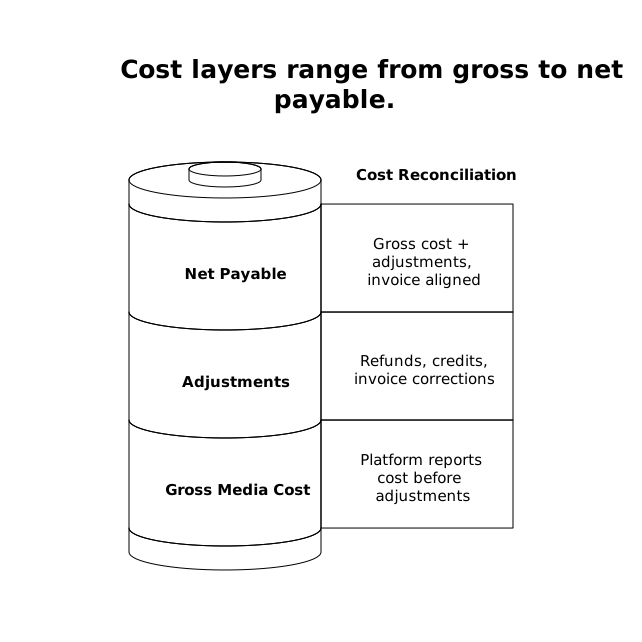
This lets marketing teams analyze efficiency with consistent “delivery cost,” while finance and forecasting can rely on “net payable.”
2) Add adjustment metadata so it can be traced
Adjustments need context to be usable. At minimum, capture:
- Adjustment type (refund, credit, invoice adjustment, make-good)
- Posting date (when it hit the platform)
- Service period (the period the adjustment relates to, if available)
- Reference identifiers (invoice ID, account ID, credit memo, or platform transaction ID)
If service period isn’t available, store “unknown” explicitly rather than forcing it into the current reporting window. That transparency prevents quiet distortions.
3) Decide how to allocate adjustments for ROI reporting
There are three common allocation strategies. Pick one, document it, and apply it consistently.
- Posted-date allocation: keep the adjustment in the period it was posted. This is simplest and matches platform exports, but creates time volatility.
- Service-period allocation: move the adjustment back to the period it relates to. This improves trend accuracy but requires reliable service-period metadata.
- Proportional allocation: distribute an adjustment across campaigns/ad sets based on their share of gross spend in the service period. This is often the most stable for ROI, but should be labeled as modeled rather than directly observed.
For channel ROI, service-period or proportional allocation generally produces the most decision-useful view. For billing reconciliation, posted-date is often the audit trail.
Building the single source of truth without creating a spreadsheet maze
Most negative spend problems start when different teams patch the issue in different places: one BI dashboard nets credits out, another keeps gross spend, and a third applies manual journal entries in a spreadsheet. The fix is to centralize definitions and transformations upstream, then distribute consistent datasets downstream.
This is where a marketing data infrastructure platform such as Funnel.io fits naturally. By collecting and normalizing data from ad platforms, analytics, and CRM sources, you can standardize spend definitions, separate adjustment fields, harmonize naming, and ensure every dashboard and warehouse table is built from the same ruleset. The point is not to replace BI; it’s to make sure BI is never guessing what “spend” means.
Data quality checks that prevent negative spend surprises
- Spend floor check: flag records where net payable < 0 and require adjustment-type validation.
- Gross vs net variance: track the ratio of adjustments to gross cost by channel to detect policy changes or billing anomalies.
- Invoice tie-out: reconcile net payable totals to invoice totals monthly; differences should be explainable by timing or missing identifiers.
Governance and visibility so stakeholders trust the numbers
Even a perfect reconciliation model fails if stakeholders can’t see which version of spend they’re looking at. Role-based visibility and clear metric labels help prevent accidental misuse, especially when finance and marketing need different views of the same underlying reality. Teams that invest in visibility and governance generally reduce “metric debates” and shorten the time from anomaly to action.
If you’re designing your reporting stack with trust in mind, the approach in role-based visibility that builds trust is a useful parallel: the same principle applies to cost definitions and adjustment handling—people need both access and context.
How to report ROI when credits exist
A practical reporting pattern is to publish two ROI lenses side by side:
- Performance ROI (delivery-cost based): uses gross media cost to evaluate optimization and channel efficiency.
- Financial ROI (net-payable based): uses net payable for budgeting, cash planning, and finance alignment.
When both are derived from the same source of truth—and adjustments are explicitly modeled rather than hidden inside spend—negative spend stops being a “broken dashboard” moment and becomes a traceable, auditable part of your marketing economics.