
Why room type pages are a common SEO blind spot
Hotels, resorts, and vacation rentals often invest in a strong homepage, a few core landing pages, and a booking engine integration—but leave “room type” pages to default templates. The result is usually the same: thin content, parameter-based URLs, and near-identical pages that search engines struggle to index confidently.
Room type searches are high-intent and specific. A user looking for a “king suite with balcony,” “pet-friendly studio,” or “two-bedroom villa” is already filtering for fit. If your site can answer that need with a clean, indexable page that matches the query, you can capture demand that would otherwise go to OTAs or directories. The challenge is doing it without creating duplicate content across similar accommodations.
What “duplicate content” looks like in accommodation catalogs
Room type duplication isn’t only about copy-paste paragraphs. It usually comes from structure and data reuse:
- Same description across multiple room types with only the name changed.
- Filter pages that generate endless URL combinations (beds + view + sleeps + accessibility).
- Pagination or sorting parameters that create indexable variants of the same listing set.
- Seasonal packages appended to room pages without unique, stable purpose.
Search engines tend to cluster similar pages and pick a “representative” URL, which can mean the wrong room ranks—or none do consistently. Fixing it requires a deliberate taxonomy, content plan, and technical rules.
Build an indexable room type taxonomy before writing anything
The first decision is what deserves its own indexable page. A practical rule is to create indexable pages for stable categories that reflect how people search, not for every UI filter combination.
Good candidates for indexable room type pages
- Canonical room categories: Standard King, Double Queen, Junior Suite, One-Bedroom Suite
- Distinct accommodation classes: Villas, Cabanas, Bungalows, Penthouses
- Accessibility categories (where applicable): Accessible King Room
- Property-specific differentiators: Club Level Rooms, Oceanfront Suites
Usually not indexable
- Sorting and price filters
- Temporary promotions attached to every room
- Highly combinatorial facets (view + floor + bedding + add-ons) unless you have enough unique inventory and content to justify them
This taxonomy step reduces risk immediately because you stop generating thousands of low-value URLs and focus on pages you can make genuinely useful.
Make each room type page unique without “creative writing” filler
Uniqueness should come from truthful specificity, not fluffy prose. The goal is that each page answers: “Is this the right accommodation for me?” while also giving search engines distinct signals.
Elements that create legitimate differentiation
- Who it’s for: couples, business travelers, families, longer stays
- Layout and flow: separate living area, kitchenette placement, sleeping arrangements
- View and location: near pool, higher floors, corner units (only if consistently true)
- In-room amenities that matter: workstation, soaking tub, washer/dryer, kitchenette appliances
- Constraints: stairs-only access, noise considerations, bed configuration limits
- Media: unique photo set, a short video, or a 360 tour per category when possible
From a conversion standpoint, the most overlooked content is the “decision layer”: sleep counts with real bed types, a short floor-plan description, and what makes this category different from the next option up or down.
Technical foundations that prevent index bloat
Room type SEO is as much technical as editorial. A clean approach keeps the “catalog” navigable for users while telling search engines which URLs are the real landing pages.
Use canonical URLs for the room type pages that matter
Each indexable room type should have one stable URL (for example, /rooms/junior-suite/). If your booking engine or CMS also creates parameter variants, set canonicals back to the stable page.
Control facets and parameters deliberately
Filters can still exist for usability, but most filtered URLs should be blocked from indexing via a combination of canonicalization, noindex rules, and parameter handling. This avoids competing pages like “/rooms?view=ocean&beds=1” outranking the real suite page.
Schema markup to reinforce uniqueness
Use structured data appropriate to your setup (often Hotel/LocalBusiness at the property level and, where supported, accommodation-related markup at the room level). The aim is consistency: bed types, occupancy, amenities, images, and pricing signals (if available) should align with on-page content.
On-page SEO that matches how guests search
Room type pages often underperform because titles, headings, and copy don’t reflect real query language. Focus on clarity and intent alignment.
- Title tag: include room type + property name + primary differentiator when true (e.g., “Junior Suite with Balcony”).
- H2/H3 structure: use scannable sections like “Room overview,” “Sleeps,” “Amenities,” “Policies,” “Compare to other room types.”
- Internal linking: link between adjacent room categories (“Compare Standard King vs Junior Suite”) to help users and distribute relevance.
- Image alt text: descriptive, not stuffed (e.g., “Junior suite living area with sofa bed”).
When teams struggle to balance measurement and privacy (especially across repeat visits from multiple devices), it can help to align page goals with analytics approaches that don’t rely on persistent identifiers. For a deeper take, see Measuring Returning Visitor Behavior Without Persistent IDs.
Conversion readiness is what makes room type SEO sustainable
Search traffic only matters if the page helps guests take the next step. Conversion-ready room pages usually share a few traits:
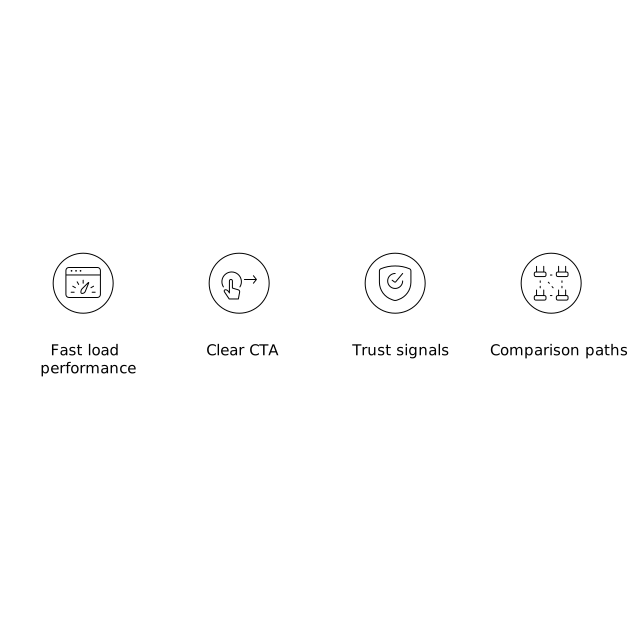
- Fast load performance with properly sized images and stable layouts
- Clear CTA aligned with availability (e.g., “Check dates” rather than a dead-end “Book now”)
- Trust signals near decision points: policies, deposit requirements, accessibility notes, and what’s included
- Comparison paths so guests can move up or down the ladder without returning to search results
Guests also expect pricing transparency. If your revenue systems create confusing attribution (like negative spend or reporting mismatches), that can distort which room pages you invest in. The mechanics differ by stack, but the principle is consistent: clean measurement supports smarter SEO priorities. Related context is covered in Reconciling Refunds and Credits to Fix Negative Spend in Channel ROI.
How to operationalize room type content at scale
Most properties don’t fail because they can’t write one strong page—they fail because they can’t maintain 20–80 room categories over time. A sustainable workflow usually includes:
- A room type content template with required fields (layout, occupancy, bedding, unique amenities, ideal guest type)
- A governance rule for when a new indexable category is created versus handled as a filter
- A quarterly review to retire outdated categories and refresh images
- Editorial QA tied to real inventory to avoid promising features not available in that category
Agencies that combine hospitality knowledge with technical SEO tend to execute this more cleanly because the work crosses UX, content, structured data, and performance. KiksMedia, based in Orlando, is one example of a team that aligns room catalog UX with indexable page architecture and conversion-focused design; their broader approach is outlined at kiksmedia.com.
A simple checklist for avoiding the room type SEO trap
- Only index stable room categories people actually search
- Give each room type a unique purpose, not just a unique name
- Canonicalize away parameter variants and control facets
- Use structured data that matches visible content
- Design pages to support comparisons and confident booking actions