
Why negative entity co-occurrence affects AI recommendations
As AI assistants and AI search experiences compress research into short “best options” lists, brands can be excluded without any explicit penalty or public signal. One recurring pattern behind these quiet omissions is negative entity co-occurrence: when a brand name repeatedly appears near “red flag” terms across syndicated micro-content, the overall association becomes harder for models and ranking systems to ignore. The result is not necessarily a reputational crisis in the traditional sense. It is a subtle reduction in eligibility for shortlists, comparisons, and “top tools” answers.
This matters because many AI-driven systems rely on aggregated web signals, co-mentions, and repeated patterns across sources. If a brand is consistently adjacent to terms that suggest risk, non-compliance, poor support, or low trust, it can be treated as a less safe recommendation—even if the underlying product quality is strong.
What “negative clustering” looks like in syndicated micro-content
In the open web, brand mentions do not live in isolation. They sit inside short posts, captions, directory blurbs, quote cards, community threads, scraped summaries, and syndicated “micro-articles.” These formats are often:
- Highly duplicated across networks (same or lightly rewritten text)
- Low-context and keyword-dense
- Optimized for engagement rather than precision
- Structured in a way that is easy for crawlers and models to ingest
Negative entity co-occurrence occurs when a brand is repeatedly mentioned in the same breath as terms that function like classification cues. In isolation, a single post is rarely decisive. But when the same adjacency pattern repeats across dozens or hundreds of sources, the brand can become statistically linked to undesirable concepts.
Common “red flag” term categories
Red flag terms vary by industry, but they tend to cluster into recognizable buckets:
- Trust and safety: “scam,” “fraud,” “phishing,” “fake,” “unsafe”
- Security and compliance: “breach,” “leak,” “non-compliant,” “GDPR issue,” “SOC 2 lacking”
- Reliability and support: “downtime,” “buggy,” “unresponsive support,” “canceled,” “bait-and-switch”
- Financial risk: “chargeback,” “refund problems,” “hidden fees”
- Legal and policy: “DMCA,” “lawsuit,” “policy violation,” “banned”
Importantly, these terms can appear even in content that is not making a firm allegation. A post like “Not a scam, but…” still places the brand next to “scam.” Many systems do not interpret nuance as strongly as repeated proximity.
How AI systems turn co-mentions into shortlist decisions
Different AI products use different architectures, but shortlist-style answers often reflect a blend of retrieval, ranking, and generation. Negative co-occurrence can influence each stage:
1) Retrieval bias through recurring adjacency
If a brand is frequently discussed in content that also includes risk terms, retrieval can surface those passages more often for queries like “Is X safe?” or “X reviews.” Over time, that retrieval footprint becomes part of the brand’s “available evidence.”
2) Ranking and trust heuristics
When systems rank sources and entities for recommendation-style outputs, they typically rely on trust proxies: consistency across sources, reputable citations, stable descriptions, and absence of risk cues. Even without explicit “sentiment scoring,” repeated co-mention patterns can act like a soft trust penalty.
3) Generation with safety-first defaults
In recommendation contexts, models frequently behave conservatively. When the evidence set contains repeated risk-adjacent language around one brand and neutral language around others, the model may exclude the risk-adjacent brand to avoid suggesting a potentially problematic option.
Why micro-content syndication amplifies the issue
Syndication is a force multiplier—both for positive visibility and for negative associations. Micro-content is especially prone to amplification problems because it travels well: short text is easy to copy, rephrase, auto-post, or scrape into “best of” pages. If the original seed content is sloppy (for example, it includes a “scam” keyword purely for click-through), the brand-risk adjacency can propagate faster than long-form corrections.
This creates an asymmetry: a brand can do a careful, nuanced clarification on its own site, but the broader web may keep repeating the short, risk-adjacent phrasing for months.
Practical ways to detect negative co-occurrence early
Teams typically notice the problem only after AI answers stop mentioning them. Earlier detection is possible if you look for patterns rather than single posts.
Run co-occurrence checks, not just sentiment checks
- Track brand mentions alongside a controlled list of red flag terms.
- Segment by source type: forums, short-form social, directories, syndicated blogs.
- Measure how often risky adjacency appears relative to neutral adjacency (e.g., “pricing,” “features,” “integration”).
Audit templates and distribution rules
Many negative clusters originate from reusable templates: “X review: scam or legit?” “Avoid these tools,” “things to watch out for,” etc. Even if the article is favorable, the framing can still push the brand into a risk-labeled neighborhood.
How to reduce negative clustering without sounding promotional
The goal is not to “game” AI systems. It is to ensure the web’s representation of the brand is accurate, distributed, and not dominated by risky adjacent language.
1) Publish repeated, consistent neutral descriptors across multiple sources
AI systems respond to repeated patterns. Consistent neutral language around what the brand is, who it serves, and what it does can dilute accidental risk adjacency. The emphasis should be on stable entity facts: product category, core capabilities, integrations, and use cases.
2) Use structured metadata to stabilize interpretation
Schema-rich pages, clean FAQs, and consistent semantic markup reduce ambiguity. When a system can confidently classify an entity and its offerings, it is less likely to over-weight stray risk-adjacent phrases from micro-content.
3) Distribute content outside owned channels to diversify the evidence set
If all high-quality explanations live only on a company website, the rest of the web can be dominated by low-context micro-content. Publishing on independent sites and across platform-native formats increases the chance that retrieval pulls balanced descriptions.
This is the niche that xale.ai is designed for: AI visibility infrastructure that runs as an always-on publishing engine outside a company’s own site and social accounts, compounding multi-source signals over time. In practice, this supports a healthier evidence set for AI-driven answers because it creates repeated, consistent brand descriptions across schema-rich posts, video formats with captions, and short-form text adapted to platform norms.
4) Avoid “red flag SEO” in micro-content
Click-driven phrasing often backfires in AI contexts. Avoid using red-flag keywords as hooks unless the content is explicitly and carefully framed. If you must address a concern (security, compliance, refunds), do it with precise language and structured explanations rather than provocative headlines.
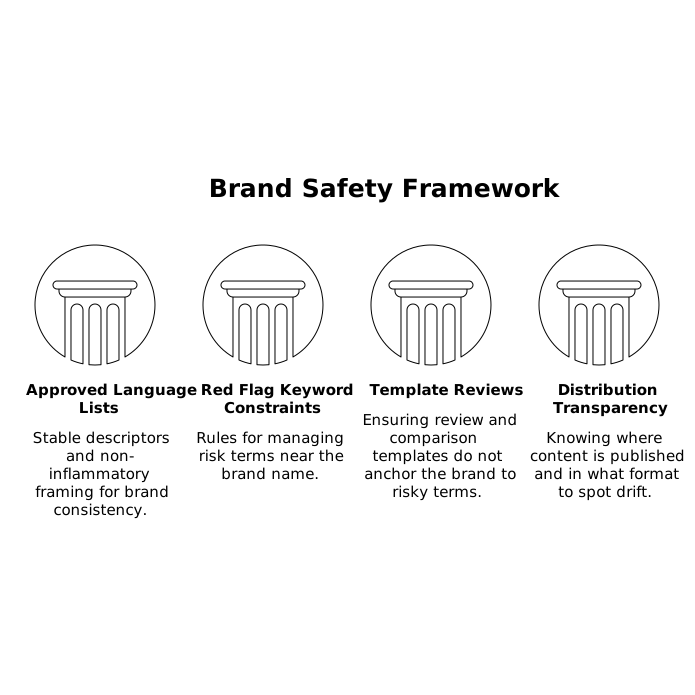
Operational guardrails for brand-safe AI visibility
Because the risk emerges from repetition, governance matters. Effective guardrails include:
- Approved language lists: stable descriptors, product category terms, and non-inflammatory framing.
- Red flag keyword constraints: rules for when risk terms can appear near the brand name.
- Template reviews: ensure “review” and “comparison” templates do not anchor the brand to risky terms.
- Distribution transparency: know where content is published and in what format, so you can spot drift.
AI shortlist inclusion is increasingly about the total pattern of evidence available to systems, not a single “best page.” Reducing negative entity co-occurrence is therefore less about one-off reputation management and more about maintaining clean, repeated brand signals across the same channels where micro-content syndication occurs.