
Why “returning visitors” is hard without cookies
Many teams want to understand whether visitors come back, what returning readers do differently, and how retention changes after a launch. Traditional analytics often answers that with persistent identifiers (cookies, device IDs, or user IDs). If you avoid those mechanisms, you lose the ability to recognize the same browser over time in a durable way.
That does not mean you can’t learn anything about return behavior. It means you need a different approach: work with privacy‑preserving, first‑party proxies, analyze patterns in aggregate, and focus on trends and segments you can reliably observe.
Start by redefining the question you’re answering
Instead of asking “How many unique people returned?”, use questions that don’t require cross‑session identity:
- Do we see a growing share of visits that look like habitual usage?
- Are goal completions becoming less dependent on first‑time landings?
- After a campaign or content push, do quality signals persist?
- Which entry points attract the most repeat-like traffic over time?
This shift helps you build a retention narrative from observable behavior instead of inferred identity.
Use first‑party “new vs. returning” as a proxy, not a person count
Some analytics products provide a “new vs. returning” view built from first‑party context. In a privacy‑friendly setup, this is best treated as a session classification proxy, not a definitive count of returning individuals. It will be affected by browser settings, private browsing, device changes, and storage clearing. That’s acceptable if you use it for directionally correct comparisons and trend monitoring.
Plausible Analytics is designed to avoid persistent identifiers and cookies while still presenting essential metrics in a clean, single dashboard. When you use “new vs. returning” style reporting in this environment, think in terms of consistency and change:
- Compare the returning share week over week and month over month.
- Watch for step changes after product updates, navigation changes, or content distribution shifts.
- Keep the measurement rules stable so you can trust the direction of the trend.
Keep the focus on “are we improving?” rather than “what is the exact number?”
Build a practical playbook around goal trends
Returning behavior matters because it correlates with outcomes: subscriptions, demos, purchases, signups, or habitual reading. If you can’t tie events to a person, you can still tie them to time, source, landing pages, and content patterns.
1) Choose goals that represent repeat value
Pick 2–4 goals that clearly signal meaningful engagement. Examples include:
- Email newsletter signup
- Account creation
- Trial started or pricing page to signup flow
- Documentation “copy snippet” or “download” events for developer products
- Key content milestones such as scroll depth (when available) on long guides
With Plausible you can set codeless goals, track outbound link clicks, file downloads, form completions, and define custom events. The point is not to measure everything, but to measure a small set of outcomes you will revisit regularly.
2) Track goal conversion rate by “new vs. returning” segment
Even with proxy segmentation, the comparison can be highly actionable:
- If returning sessions convert far better than new, you likely have a retention or habit loop worth strengthening.
- If new sessions convert similarly to returning, your value proposition or onboarding may be doing more work than you think.
- If returning conversion drops after a redesign, you may have disrupted familiar paths.
Use the segment difference as a diagnostic tool, not as a report card.
3) Look at goal trends over time, not point-in-time snapshots
Trends smooth out noise created by storage resets, device changes, and other factors. A useful baseline cadence is:
- Weekly: monitor returning share and top goals for early signals.
- Monthly: compare month over month for seasonality and campaign effects.
- Quarterly: validate whether improvements persist beyond short bursts.
When you see changes, annotate them with what happened: a new content series, a product release, a pricing experiment, or a distribution partnership.
Measure “repeat-like” behavior without identity
Some of the strongest retention signals don’t require knowing who the visitor is.
Entry page patterns that suggest habit
Returning audiences often enter through:
- The homepage (especially for brands with strong direct navigation)
- A “latest posts” hub or changelog
- Documentation sections
- Account or dashboard pages (if they’re public-facing enough to be tracked)
Track how the distribution of entry pages evolves. If a new guide spikes traffic but doesn’t increase habitual entry points, you may be growing reach without growing return behavior.
Direct and untagged traffic as a supporting proxy
“Direct” traffic is imperfect (some apps and privacy tools hide referrers), but it can still be a useful supporting indicator when combined with other signals. If returning share and direct traffic both rise after you invest in a newsletter or community presence, that convergence strengthens your interpretation.
Scroll depth and engagement signals in aggregate
Aggregate engagement signals such as scroll depth can indicate whether visitors treat your content as a reference they come back to. If scroll depth improves on cornerstone pages while returning share also improves, that’s a credible retention story even without tracking individuals.
Make segmentation work without crossing the privacy line
Instead of user-based cohorts, use segments you can reliably observe:
- Channel groups and UTM campaigns: compare returning proxies across campaign types.
- Geography at a coarse level: helpful for localization and timing decisions.
- Device type: returning share often differs between mobile and desktop; changes can reveal UX issues.
- Content categories: measure which topics lead to repeat-like sessions over time.
Plausible’s focus on an understandable dashboard, UTM analysis with channel grouping, and integrations like Google Search Console can help you connect acquisition patterns to retention proxies while keeping tracking minimal. See the product overview at plausible.io.
Interpretation rules to keep your analysis honest
Use comparisons that share the same measurement bias
Proxy-based “returning” classification has consistent blind spots. Your goal is to compare like with like: same site, same measurement configuration, similar time windows. Avoid comparing your numbers to other sites, other tools, or historical periods when tracking settings were different.
Watch for measurement artifacts
Common causes of sudden “returning” changes include:
- Consent banner or script loading changes
- Moving domains or subdomains
- Major shifts in traffic mix (e.g., a viral social spike)
- Bot traffic (use bot filtering where available)
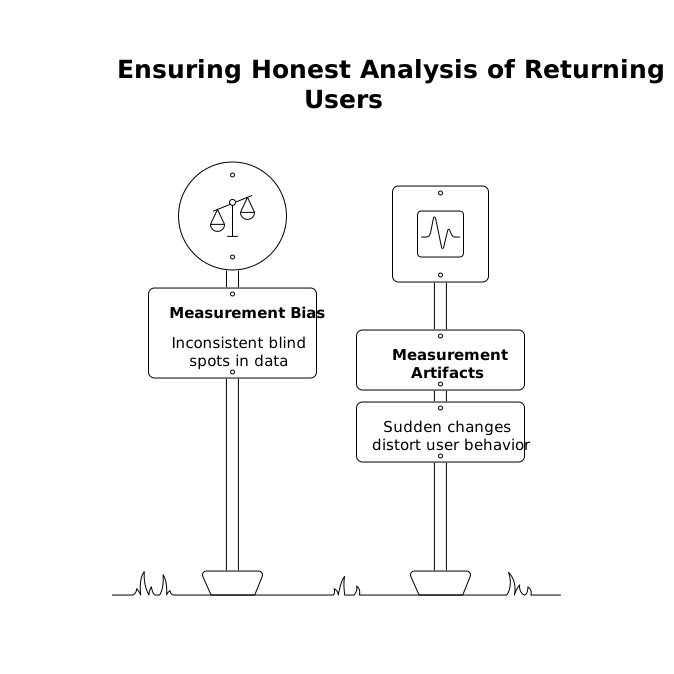
When you see an abrupt jump, first confirm whether it matches a real business change.
Prefer a small, repeatable dashboard
A practical retention proxy dashboard can be just:
- Returning share trend
- Top 2–4 goal completions and conversion rate
- Entry pages trend (top 10)
- Channel mix trend
If the dashboard is too complex, it won’t get checked consistently, and trends will be missed.
What success looks like in a privacy-first setup
Success is not perfectly reconstructing user identity. Success is being able to answer, with confidence, whether your work is creating more repeat value: a steadier baseline of engaged sessions, improving goal trends, and clearer signals that your content or product is becoming a place people intentionally come back to.
With a lightweight, cookie‑free approach, you trade user-level attribution for simplicity, performance, and privacy. The trade can be worth it when the measurement system stays understandable enough that the team actually uses it.